Celtic sailors, inspired by the rich maritime traditions of Celtic cultures, often symbolize resilience and adventure. Their stories resonate through history, reflecting the connection between the sea and Celtic mythology.
EL.GGoDo’s Celtic Sailor
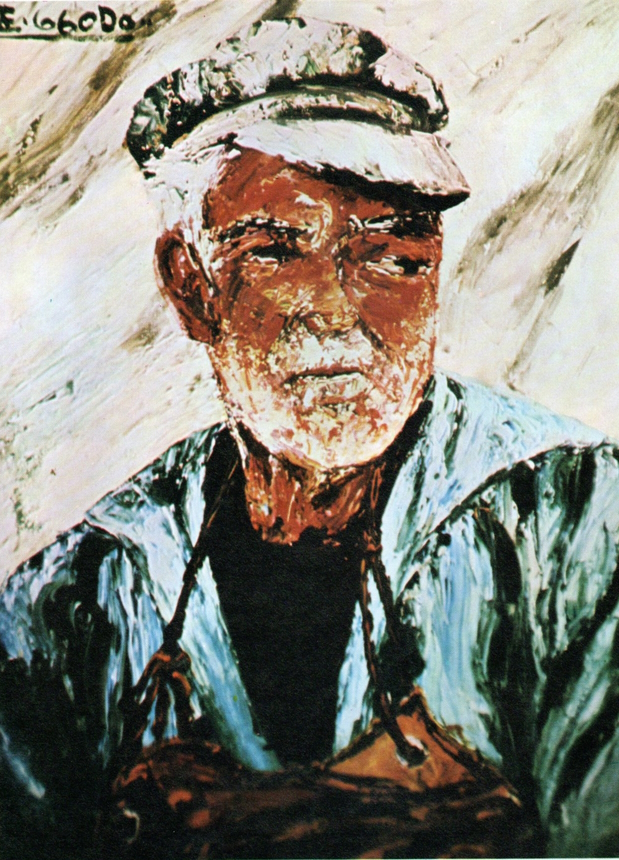
One notable depiction of this theme is EL.GGoDo’s “Marinero Celta” or Celtic Sailor, painted in 1969, catalogue no. 156. This artwork encapsulates the spirit of the Celtic sailor, merging artistic expression with historical reverence. The piece invites viewers to explore the elements of bravery and exploration that define the Celtic seafaring tradition.
Characterized by bold colors and dynamic forms. The piece captures the intensity of the sailor’s emotions and experiences, inviting viewers to immerse themselves in the vibrant world of Celtic seafaring tradition, intertwining artistic expression with historical reverence. It invites exploration of bravery and the profound connection to the sea that defines the Celtic maritime narrative.
The article written by Mr Fulgencio Fernandez, titled: “El hombre que pintaba a cuatro manos con Dios”, can be found at this website (written in Spanish): https://www.lanuevacronica.com/el-hombre-que-pintaba-a-cuatro-manos-con-dios and I have translated to English using Google translate so interested readers may get an idea of what it is about. I will put my responses in square brackets [ ] to distinguish it from the original text. I was going to ignore this work of Mr Fernandez but I think it is important to reply to some of remarks in his article.
Before I start I would like to say that overall the article appears to have taken parts of what I wrote about my father and smashed it together with what he wrote about himself on elggodo.com and throwing in some imagination along the way to create an article which is not completely true more of a tale than a factual piece of writing.
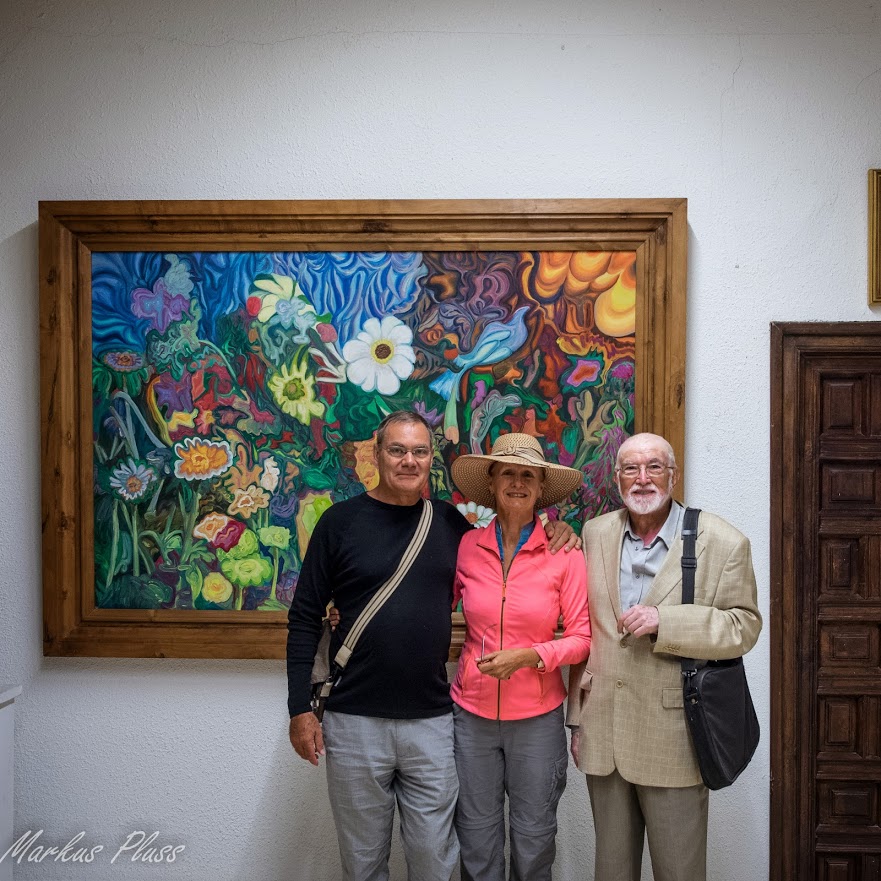
Also the image of my stepfather, mother and my Dad in front of the painting Libertad was used in the article without permission and my stepfather’s name was removed from the image as far as I can tell.
Original image taken unaltered from elggodo.com
“The man who painted four hands with God
by Fulgencio Fernandez of the La Nueva Cronica (Leon, Spain)
THE UNFORGETTABLE El Ggodo, from Veneros from Leon, is one of those unclassifiable and unrepeatable types; a painter of extensive work, a businessman with pearls grown in Japan … he ended his days mentally ill walking around Ordoño II with 5 hats and fleeing from aliens
[It is true to say my father was unforgettable and his artistic name was EL GGoDo (that’s the way he wrote it – he liked to be different) but the part about wearing 5 hats is just a pure fabrication and should not be read literally in my view.]
Avelino Paredes tells how he won a short story award thanks to the impact that the jury had caused by the start of it, which said: «What a disappointment I was when I read Don Quixote, I expected the most outlandish being in the world and I found that it was much less so than Ismael, the shopkeeper of my childhood.
[Maybe my father was a tiny bit like Don Quixote in that he was different not that everything he did was fabrication. My father had a book which documented in great detail most of his life which I saw myself and it had him next various well known people, however in the last five or so years of his life that the book had been stolen or perhaps misplaced…, I don’t think my father cared all that much because he knew what he had achieved in his life since making a good living for himself and retiring comfortably.]
It would be worth the beginning for the biography of Pedro Rodríguez, from Leon, with the artistic name El Ggodo de Veneros, painter, globetrotter, provocateur, a type who does not leave indifferent, unclassifiable, always surprising in his answers and with a biography that includes numerous stories, travels, countries, marriages … battles darkened in his last years by a mental illness, until he passed away a few months ago, in June, leaving behind the largest trace of anecdotes imaginable.
[My father, yes, loved to tell stories but what is wrong with that. ]
Give a couple of examples of some of his unexpected departures. He gave a painting to the Museum of the Cathedral of León (Libertad, donated in 1995) and at the press conference, after confessing himself an atheist, explained that «the Cathedral is the ideal place for this work because in a man-God conjunction of difficult explanation was a divine breath that led my hand and the paintbrushes ». Then he valued the work at 500,000 million (pesetas).
[My father believed in himself and his artwork…]
Also in those years he went to La Crónica de León, hired an advertising page and in it he simply wrote in large letters: «El Ggodo spends the winter in León. His work “Celtic Sailor, valued at a billion, too.”
[Ditto]
You will have seen his works in a doctor’s office, in offices, bars in half the province, since there are more than two thousand documented works, (in the 90s he made a catalog that already required two large volumes); works that are a tiny part of a vast biography, which begins in March 1933 when he was born in Veneros, then a mining town, but he was the son and grandson of wood artisans, to whom his “artistic vein” is attributed.
[Yes, true enough, thank you to all those people who purchased my father’s works or did a favour and received payment-in-kind.]
Bilbao, Japan, wedding with a tennis player
At the age of fifteen, Pedro’s family moved to Bilbao and he delved into the study of art, a hobby that already came from his childhood school, but he earns his living working in a family business that allows him to travel throughout Europe , gets married and has his first daughter; until at the age of 31 he decided to dedicate himself to art and, in his expression in a long interview with La Crónica when he donated his painting to the Cathedral – he has other donations in other museums – «I went hungrier than the mules from the Veneros mine when they marched and they left them there. Of that first marriage [What’s coming is completely wrong, his first marriage was to Amita not Ana from Germany, Ana was one of his many girl friends he was a artist at heart after all.] he himself wrote: «I met Ana Janalore (German), they were the happiest years of my life. Ana was so perfect in everything that I still wonder how I separated from her. She studied at a Swiss school, spoke three languages, rode very well on horseback. Only daughter, her parents very rich. I was so happy that I didn’t know if I lived on earth or in heaven, she has been the woman who has loved me the most. On a trip to Cordoba I met Carole (American), the next day she called me on the phone and came to Madrid, we spent the night at the Hotel Cuzco, the next day Ana asked me and I told her the truth; without further ado she packed her suitcase and left for Germany. It was the worst thing I did in my life.
Pedro Rodríguez did not explain very well how but his next destination was Japan and not linked to art but to jewelry and cultured pearls. «I was 36 years old and I got into the watch business, which Japan was pushing hard, and cultured pearls, for which Japan was a paradise and I removed all the hunger that I went through before, I rubbed shoulders with the most important thing you can imagine of this country, I earned money, traveled and lived like God, in which I do not believe »(this he repeated frequently because he had just given the painting and it was a kind of provocation, so he smiled mischievously). But he did not stop painting, in fact from this time it is the work that he considered his masterpiece, ‘Celtic sailor’, which he valued at “one billion”. Regardless of the boutade that these prices may seem, it is no less true that he suffered a robbery in his house and for the trial an art professor from the University of León carried out an appraisal of the works that were not one billion but very prices. high for the time.
[When my mother first met my father he was in the cultured pearls business as well as dabbling in painting/artist. I have only really known my father as an artist, seller of his works originals, prints and poliesmaltes and as a successful trader on the stock market.]
About to turn 40, in his time of maximum economic splendor, comes the most striking passage in his biography: his wedding with a promising Australian tennis player, Susan Alexander, with whom he soon has a son, Alexander, [there is some confusion here; who wrote what] who in a short Her father’s biography describes how her mother had told her about the wedding: “Susan was an energetic idealistic young woman in her twenties, well known in the social circles of social tennis in Spain. The Ggodo was a handsome, tanned, wealthy, middle-aged man with literally a handful of sports cars, green Ford Mustangs … It would have been a perfect ‘Hollywoodstyle marriage’ if the Spanish precept had been adhered to, married once and for all, and if Susan were more homelike and less sociable! Yet another quirk from El Ggodo. However, nothing is perfect and the marriage had a sad end. End that he always regretted because he always confessed that he had been the love of his life.
This failure made him decide to leave the business world and focus again on the art world. And in traveling, his other passion, traveling through countries and cities such as Puerto Rico, San Francisco, Honolulu, New York along with stays in various parts of Africa and Russia.
[All true, as far as I know.]
Curiously, many years later, in 2017 a book entitled ‘A Spanish love affair’ was published, by Susan J. Alexander, yes the youthful love of Pedro Rodríguez El Ggodo. He tells that ‘Spanish amoir story’ and discovers that the Leonese man adopted a more ‘aristocratic’ [the name was given to my father by my mother to protect his identity – that is all. Now that my father has passed away it does not matter if he is known as Pedro Rodriguez-Fuertes (EL.GGoDo)] name: “Not wanting to spend the winter months in cold and dark London, Susan heads to Spain. She is immediately captivated by Spain, the Spanish way of life, and before long, a handsome Spaniard, Pedro Riviera de Flores. It’s love at first sight when Susan meets charming Pedro at the healthy Chamartín Tennis Club in Madrid. But love doesn’t work well after a hasty marriage and Pedro’s mysterious past.
[True enough, except for the name change as previously mentioned.]
In the 1980s he returned to León and Veneros, where he built his famous and controversial studio (Studio Europa) based on plates and tips. He paints, discusses, fifty, dreams, fables … He has spots on his skin: “It is a sect of ugly people, who do it to me out of envy”; They are the exits of Pedro El Ggodo.
[He built his new studio starting in the 1990’s not 80’s, I helped him. Regarding the spots on his skin, though I am not a medical doctor, he had hyperpigmentation you can google what that means and what it is caused by and it is certainly not what is suggested. I have got it also, big deal…]
His health is deteriorating, his neighbors recalled this phase in the town’s magazine: «After traveling halfway around the world, back to the town back in the 80’s, his pilgrim ideas were famous, such as building a giant egg on Mount Cogolla, organize Miss Veneros contests or turn the entire town into a large natural park. [turning the entire town into a natural park may have been one of his ideas, but the others are probably nonsense.] Ideas that finally came to nothing. [Perhaps they came to nothing but there is still a chance things may change as Veneros and surrounding villages and Leon, are a beautiful place.] And well known were also his eccentricities and carnival anecdotes: going to the Vegaquemada pool in the middle of summer in a bathrobe, showing off with a neighbor, painting her colorful fruit trees, renting a house next to Nisio in Voznuevo to spend a whole summer having fun with their occurrences … Let’s say ‘venial’ nonsense that soon made the logical leap and went on to more worrying behaviors such as seclusion for whole days at home with the radio at full blast tuned to any foreign station … Then he went to León, walked around Ordoño with 5 hats, put banners on the window, shopped with a harvest basket, isolated himself against aliens. Bad years for a sick man, his mental health deteriorated. Until last June 11, he went to look for the picture that he had painted half with God. [ He had periods of illness during his last days but I have rarely heard of a healthy death, he died of old age and unforntunately his close family including me could not be there mainly because of the COVID-19 restrictions. Though I am thankful that Maximo and his friends could be close by so that he did not leave this earth alone. His family were in contact with him almost right to the end via telephone, WhatsApp and Skype.]
And they say that whoever took care of him in this final stretch was … Máximo Rascón, the one who received the painting Libertad.” [He is not alone there, many people in Spain and Europe would leave this world with a priest by their side…]
[I hope this work from Mr Fernandez stimulates readers into discussing EL GGoDo’s works rather than attacking the older individual.
Please leave a comment below, for, against or “on the fence” about the article. I am interested in what people think.]
 ELGGoDo.com